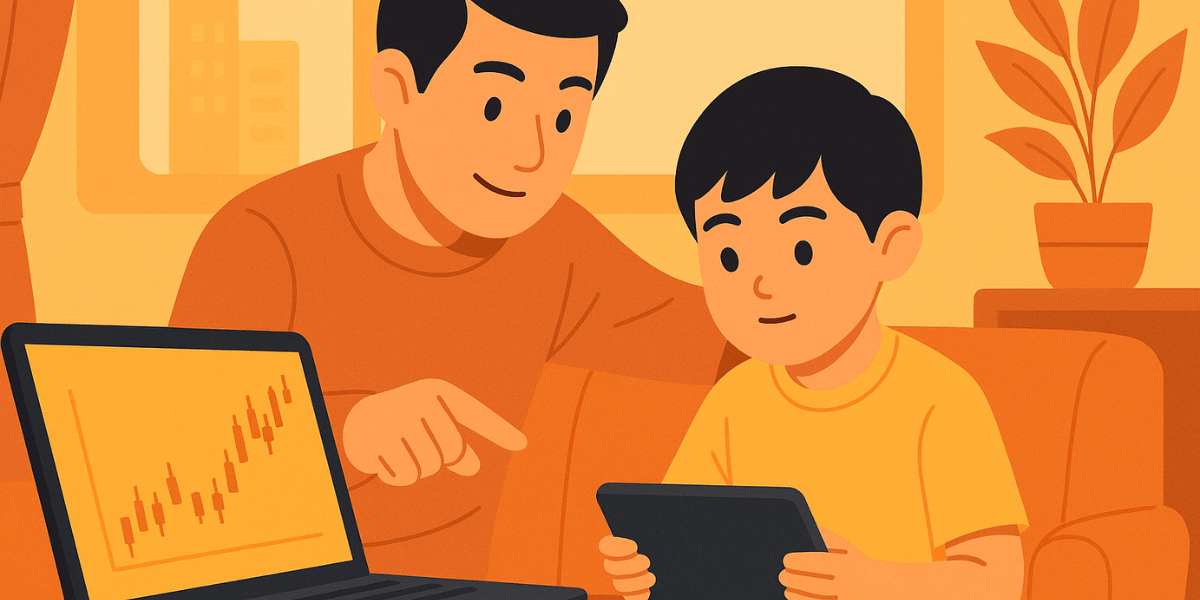
Across Asia, a new and complex debate has emerged: should minors be taught how to trade financial markets? This question, once unthinkable in traditional finance, has become increasingly relevant as teenagers across Singapore, Malaysia, Indonesia, Thailand, the Philippines, South Korea, and even Japan begin showing interest in forex, crypto, equities, and short-term speculation techniques.
With trading education migrating from classrooms to TikTok tutorials, YouTube breakdowns, Discord communities, and youth-oriented mobile apps, the topic has rapidly moved into the public sphere. While financial literacy for minors is widely encouraged, the ethical boundaries blur when literacy blends into active risk-taking.
The Asian region, shaped by diverse cultural expectations and rapidly evolving digital ecosystems, provides a unique stage for this debate. Some parents see early exposure to trading as a modern form of financial empowerment; others view it as exploitation and a psychological risk for developing minds. Policymakers, educators, and regulators are struggling to draw a line between teaching valuable financial skills and introducing minors to high-risk behaviour during a developmental period characterized by impulsivity and emotional volatility.
This article explores the ethical dimensions of teaching trading to minors in Asia. It analyzes cultural factors, regulatory inconsistencies, parental expectations, the influence of digital finance trends, and the psychological implications of exposing teenagers to tools originally designed for adults with stable cognition and income. The objective is not to offer a verdict, but to map the contours of a debate that is becoming unavoidable.
The Changing Landscape of Youth Financial Exposure in Asia
For decades, financial education among Asian youth was limited to concepts like saving, budgeting, and disciplined spending. Investment, if mentioned at all, was treated as an advanced adult activity. But today’s adolescents live in an environment fundamentally different from that of previous generations. Markets are accessible through a single tap on a mobile phone. Apps simulate real trading with gamified interfaces. Influencers present trading as a skill to be mastered early. Social media collapses the once-clear separation between professional investors and teenage consumers.
Minors in Asia frequently encounter content about forex pairs, cryptocurrencies, meme-stock rallies, day-trading strategies, and futures markets long before they encounter traditional lessons about bank savings or long-term investment principles. The phenomenon is not limited to financially affluent families; digital access has democratized exposure across socioeconomic lines. Students in Manila, Jakarta, and Bangkok can watch the same trading tutorials as students in Seoul or Singapore.
The result is an environment where minors are not only aware of trading—they are fascinated by it. They see peers turning small savings into speculative opportunities. They observe viral success stories. They witness real-time market reactions to global events. And in this context, educators and parents must confront an ethical dilemma: should this curiosity be cultivated or regulated?
The Ethical Core of the Debate: Education vs Risk Induction
At the heart of the debate is a distinction between two concepts often conflated: teaching about trading and encouraging minors to trade. Teaching about trading involves concepts such as supply and demand, market cycles, fundamental principles, risk management, and long-term investment philosophy. Encouraging minors to trade, on the other hand, involves directly exposing them to platforms where monetary losses are possible and highly probable.
In Asia, the boundary between education and speculation is especially sensitive. Parents often value academic excellence and emotional discipline, yet the region has also developed a reputation for fast-paced speculative culture. The allure of quick gains can conflict with educational intentions.
If minors learn through paper trading or simulations, the ethical concerns diminish. The risk emerges when algorithms, leverage, real capital, and emotional highs and lows become part of the learning environment. The question becomes: is it ethical to expose a developing mind to market stress, dopamine cycles, and the potential for financial loss?
Regulatory Inconsistencies Across Asia
Asian countries vary dramatically in their stance on minors and market participation. Some jurisdictions clearly prohibit minors from opening trading accounts, while others allow it if sponsored by parents. There are regions where minors use the accounts of adults informally, bypassing regulatory intent entirely. And in the crypto space, regulatory clarity is even more fragmented.
In Singapore, for example, the Monetary Authority of Singapore enforces strict guidelines on suitability and classification of retail investors. Minors cannot open brokerage accounts independently, but parents can introduce them to educational tools and non-monetary simulations. South Korea enforces strong age restrictions for securities accounts. Japan allows minors to own investment accounts under custodial structures. In Southeast Asia, however, enforcement varies widely, and the rise of offshore broker access complicates the matter further.
The ethical question becomes more pronounced when accessibility bypasses regulation. Even if minors are technically prohibited from trading real capital, they can be exposed to platforms through shared devices, borrowed identities, or unregulated crypto exchanges. This raises the concern of whether teaching minors about trading inadvertently encourages them to circumvent regulations.
The Psychological Perspective: Are Minors Ready for Risk?
Developmental psychology plays a critical role in this debate. Minors, especially those under 16, are still undergoing cognitive maturation. Their prefrontal cortex—the part responsible for decision-making, impulse control, and risk assessment—is not fully developed. This affects the ability to handle losses, regulate emotions, and resist addictive behaviours.
Trading requires emotional resilience, the ability to withstand uncertainty, and an understanding of probabilistic outcomes. These traits often develop through experience and maturity. Exposing minors to high-risk environments may create emotional patterns that are detrimental in the long term. Loss-chasing behaviours, compulsive trading impulses, performance anxiety, and unrealistic expectations can imprint themselves early.
It is also important to consider that minors often struggle to separate skill-based outcomes from luck. A few early wins can create an inflated sense of ability. A series of losses can produce emotional distress disproportionate to the monetary value involved. Without strong psychological guidance, early exposure can do more harm than good.
The Cultural Angle: Asian Expectations and the Pressure to Perform
In many Asian cultures, success is measured by academic performance, discipline, and the ability to secure a stable future. Parents push for early development of competitive skills. Teenagers face intense expectations across many domains: school rankings, extracurricular achievement, and future career choices. When trading is introduced, these expectations can distort the purpose of financial education.
Some parents view trading as a modern skill with economic promise—something like coding or robotics. Others see it as a shortcut to financial independence. But for minors, the introduction of trading can amplify existing pressures. They may begin to equate self-worth with market performance. They might feel compelled to outperform peers in yet another competitive arena.
The ethical tension increases when trading becomes a performance metric rather than a learning tool. This is particularly sensitive in countries where educational pressure already contributes to high rates of burnout, anxiety, and depression among youth.
Influencer Culture and Minors: A Risky Intersection
One of the most pressing ethical concerns is the role of influencers in shaping minors’ views on trading. Social media platforms across Asia are filled with content creators presenting trading as a glamorous, fast-paced, and easily accessible route to financial success. The boundaries between entertainment, education, and persuasion are often blurred.
Minors frequently consume this content without understanding the disclaimers or the underlying risks. Many influencers simplify complex trading concepts, display unrealistic profit expectations, or selectively highlight successful trades. When minors absorb this narrative, they may develop distorted perceptions of what trading is and how difficult it truly becomes in practice.
The ethical burden is not solely on influencers. Platforms themselves must consider whether minors should be algorithmically targeted with trading content. Parents and educators must confront a digital environment that encourages financial experimentation without adequate safeguards.
Should Trading Be Taught as Financial Literacy Instead?
One proposed ethical middle ground is shifting from “teaching minors to trade” toward “teaching minors about markets.” This approach emphasizes understanding financial systems, market structure, risk, saving, and long-term investment planning. Instead of focusing on execution and profit-driven strategies, minors receive conceptual education that prepares them for the financial world without exposing them to harmful behaviours.
For example, teaching a minor about diversification, inflation, supply and demand, and long-term compounding has lasting value and poses no direct risk. Introducing them to leveraged CFDs, crypto derivatives, or scalping systems could, by contrast, distort their financial perception and create unhealthy associations with risk and reward.
Asian educators increasingly advocate for this distinction, arguing that financial literacy is essential, while active trading should be reserved for adulthood. This framework respects the need for financial education without crossing ethical boundaries.
Parent-Led Trading Education: Ethical or Problematic?
Some parents opt to teach trading directly to their children, believing early exposure will prepare them for an increasingly digital financial future. But even in a controlled environment, ethical questions arise.
Parents may expose their children to personal trading stress, projecting their emotions or losses onto them. They might unintentionally encourage risk-taking behaviour by celebrating profitable trades or showing disappointment in poor outcomes. The household atmosphere can shape the child’s emotional relationship with money in ways that are difficult to reverse.
On the other hand, ethical teaching is possible if parents focus strictly on conceptual learning, avoid real-money trading, and separate emotional behaviour from instruction. But in practice, these boundaries are challenging to maintain consistently.
Educational Institutions: Should They Participate?
Some schools and learning centres in Asia have begun offering “trading workshops” or “market bootcamps” for teenagers. These programs raise significant ethical questions. Should an educational institution endorse speculative financial behaviour, even through simulation? Does teaching trading mirror teaching entrepreneurship, or does it deviate too far into risk-based domains?
The challenge is framing. If trading is presented as a subset of economics, behavioural finance, or digital literacy, institutions have an argument. If marketed as a skill to earn money quickly, the ethical standing deteriorates rapidly. The key determinant is whether the educational objective is critical thinking or speculative motivation.
The Argument for Allowing Trading Education for Minors
Despite the risks, some experts argue that teaching minors about trading can produce positive outcomes if structured correctly. They claim that early exposure builds financial maturity, technological literacy, and an understanding of global markets. It may equip young individuals with tools needed to navigate the digital economy of the future.
Supporters also argue that shielding minors from financial risk entirely is unrealistic. Adolescents already engage in financial decision-making through online purchases, gaming economies, and digital wallets. Teaching them how markets work could reduce future vulnerability to scams, impulsive investments, or emotional decision-making as adults.
From this perspective, the ethical challenge is not the subject matter itself, but the way it is taught, the tools provided, and the safeguards implemented.
The Argument Against Teaching Trading to Minors
Critics emphasize that early access to trading can reinforce harmful psychological habits. The brain of a minor is highly susceptible to dopamine-driven activities, and trading platforms are designed with feedback loops similar to games. This can lead to addiction-like behaviour, loss aversion trauma, or unrealistic financial expectations.
There is also the socioeconomic concern: in regions where families struggle to meet basic needs, minors might feel compelled to help financially through risky trading attempts. The belief that trading offers a shortcut could distract from education and long-term stability, especially in communities already facing economic pressure.
Critics argue that the ethical risks outweigh the potential benefits and that financial literacy—not speculative training—should be the focus.
A Balanced Perspective: Where Asia Might Go Next
The solution may lie in a hybrid approach. Instead of banning all exposure or encouraging speculative behaviour, Asia could adopt a curriculum that teaches minors about markets without allowing real trading activity. Simulations, market theory, behavioural finance, and lessons on risk can provide meaningful growth without endangering psychological or financial wellbeing.
Regulators may eventually develop guidelines specifically for youth-focused financial education, distinguishing permissible content from harmful content. Schools may integrate financial literacy programs emphasizing long-term investing. Parents may be encouraged to support conceptual learning without exposing minors to emotionally charged trading environments.
The debate will not end soon. But what emerges from Asia’s discussion will likely influence global standards, given the region’s unique blend of digital innovation, cultural expectations, and economic diversity.
Conclusion
Is it ethical to teach trading to minors in Asia? The answer is complex. It depends on intent, method, supervision, and context. Trading can empower or harm, educate or mislead. Minors stand at the intersection of curiosity, vulnerability, and opportunity. The responsibility lies with educators, parents, policymakers, and platforms to ensure that financial education nurtures growth without exposing young individuals to psychological or financial risks they are not prepared to handle.
Asia’s debate reflects broader questions about youth empowerment in the digital age: how much is too much, how early is too early, and what kind of financial knowledge truly benefits future generations? The coming years will likely bring clearer policies, more structured educational models, and a deeper understanding of how to balance financial literacy with ethical responsibility.
Frequently Asked Questions
Can minors legally trade in Asia?
In most Asian jurisdictions, minors cannot open independent trading accounts. Some countries allow custodial accounts managed by parents, while others strictly prohibit any market participation. In the crypto space, age restrictions vary widely and are often poorly enforced.
Is it safe for minors to learn about trading?
Learning about markets in a conceptual sense is generally safe and even recommended. The risk emerges when minors engage in real-money trading or emotionally charged speculative activities without proper guidance or maturity.
What is the biggest ethical concern?
The primary concern is emotional and psychological readiness. Trading can trigger impulsivity, loss aversion, and addiction-like behaviour in minors whose cognitive control mechanisms are still developing. Financial loss is a secondary concern compared to emotional impact.
Should schools teach trading?
Schools may teach financial literacy and market concepts, but speculative trading techniques should be approached with caution. Ethical implementation requires clear boundaries, academic framing, and a focus on long-term understanding rather than short-term gains.
Note: Any opinions expressed in this article are not to be considered investment advice and are solely those of the authors. Singapore Forex Club is not responsible for any financial decisions based on this article's contents. Readers may use this data for information and educational purposes only.