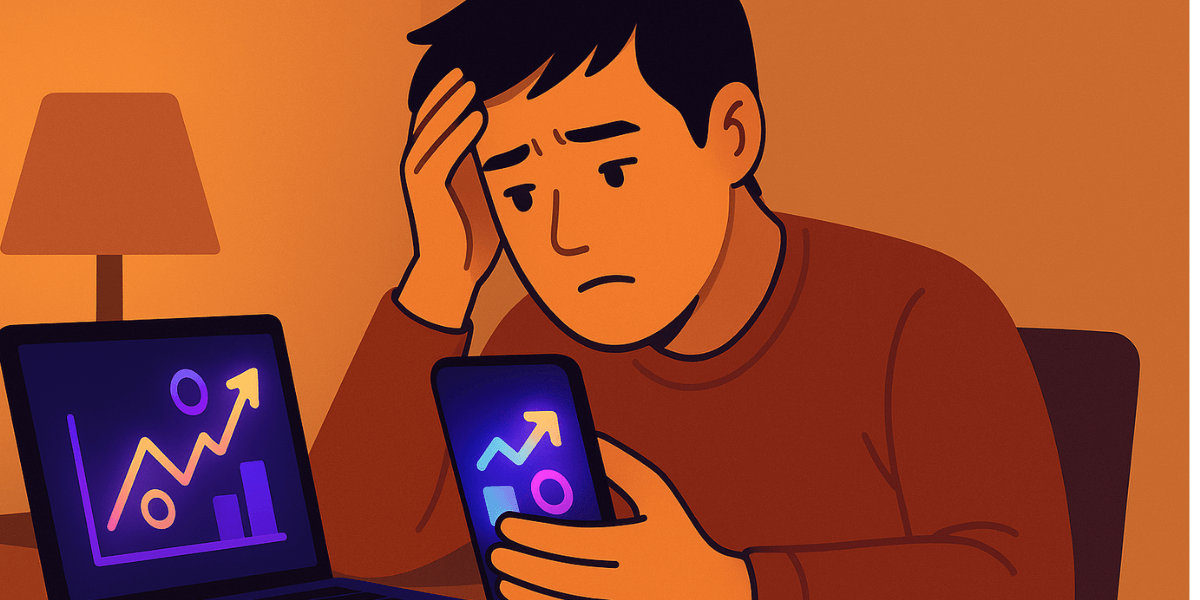
Across Asia’s rapidly growing retail trading scene, one statistic circulates quietly among brokers, educators, and analysts: the average young trader burns their first account far faster than they expect. In countries like Indonesia, Malaysia, the Philippines, Vietnam, Thailand, Korea, and even Singapore, platforms are registering an accelerating trend. Younger traders, particularly those under the age of twenty-five, open their first live account with enormous enthusiasm, a strong sense of possibility, and very little structural understanding of how quickly risk compounds. What happens next follows a disturbingly predictable timeline.
While the exact number varies by country, the pattern remains remarkably consistent. Young traders enter markets with outsized confidence, underestimate the power of leverage, and overestimate their emotional resilience. They trade too quickly, too large, too often, and with a mindset shaped more by online clips and social media narratives than by actual market mechanics. As a result, the life span of a first trading account in Asia is dramatically shorter than most newcomers imagine. This article explores how long it truly takes, why it happens, and what deeper psychological and cultural forces drive this early destruction of capital.
The First Account Phenomenon: A Pattern Before It Becomes a Statistic
The destruction of a first trading account is almost a rite of passage in Asia’s retail trading ecosystems. Talk to experienced traders in Jakarta, Kuala Lumpur, Manila, or Bangkok, and most will admit that their first account did not survive long. Some blew it in a day, others in a week, a few stretched it over a month, but the majority fall somewhere in between. This shared experience forms the cultural backdrop behind trading education in Asia: everyone remembers the first account because it exposes every weakness at once.
For younger traders, the experience is intensified by emotional impulsivity and by the digital environments they grew up in. They are accustomed to immediate reward cycles, fast content, rapid feedback, and nonlinear amplification of attention. Trading, however, punishes impatience brutally. Every impulsive decision is multiplied by leverage. Every hesitation becomes a missed exit. Every emotional reaction expands drawdown. Without risk frameworks, the account quickly becomes a mirror of psychological instability.
How Fast Do Young Asian Traders Burn Their First Account?
Based on internal data from multiple brokers operating across Southeast Asia, the average young trader burns their first account in a span ranging between three days and two weeks. This range varies by region, market, and initial deposit size, but the pattern remains unmistakable. High leverage accelerates losses, emotional turbulence drives impulsive decisions, and the absence of any structured approach allows errors to compound faster than traders can react.
In emerging markets like Indonesia and the Philippines, the average lifespan skews toward the shorter end due to the prevalence of small accounts and ultra-high leverage offerings. In more developed markets like Singapore, where leverage is more controlled and deposits tend to be larger, the lifespan stretches slightly—but not by much. Even in regulated environments, lack of experience remains the primary driver of rapid loss.
Why the First Blow-Up Is So Fast: Psychological, Cultural, and Technological Drivers
Young traders do not burn their accounts quickly merely because they lack knowledge. The deeper issue is that they enter the markets shaped by a digital culture that rewards speed. They consume trading content on platforms like TikTok, YouTube Shorts, Reels, and Discord channels where fast profits are glorified and long-term discipline is rarely depicted. This creates a subconscious expectation that trading should feel exciting, fast-paced, and emotionally stimulating.
Culturally, young Asians often face high expectations of performance—in school, in work, and increasingly in financial independence. This creates internal pressure to succeed early, sometimes before mastery has been developed. Combined with the illusion of accessibility provided by mobile-first trading apps, many young traders underestimate the complexity of markets and overestimate their natural intuition. The result is a mindset where risk feels like an opportunity instead of a threat.
Technologically, the ease of execution plays a critical role. Young traders today can open and close positions instantly with a swipe, tap, or button press. There are no frictions to slow down decisions, no pauses that force reflection, and no natural barriers that once protected traders from impulsive execution. This frictionless environment accelerates bad decision-making and magnifies the speed at which losses accumulate.
The Role of Leverage in Shortening the Lifespan of the First Account
One of the most defining features of the Asian retail landscape is the widespread availability of high leverage. Young traders regularly encounter ratios of 1:500, 1:1000, or even 1:2000. To an inexperienced trader, leverage feels like a tool for opportunity. They see it as a way to “grow a small account fast” or “maximize the chance to profit.” But leverage does not increase opportunity without concurrently increasing danger. It multiplies losses in the same proportion that it multiplies profits.
For young Asian traders with small starting balances, this becomes a fatal combination. They enter positions sized far beyond what their capital can absorb, assuming that a few pips in the right direction will compensate. When the market moves against them—as it inevitably does—margin erodes quickly, stop-outs happen almost instantly, and the account collapses before they have time to react. The experience feels shocking, even though it is entirely predictable.
The Fast Decay Pattern: How Account Losses Accelerate Over Time
The destruction of a first account rarely follows a linear path. Most young traders start cautiously, open their first few trades with some hesitation, and initially avoid extreme positions. But as soon as small early gains appear, confidence grows disproportionately. They interpret minor wins as validation, assuming trading is more intuitive than it actually is. This rising confidence triggers larger trades, more frequent entries, and riskier decisions.
Then the market turns. The first loss feels manageable, but it disrupts their newfound confidence. They enter another trade quickly to recover, escalating risk. This leads to the next loss, which triggers frustration. Soon, the trader begins trading emotionally, chasing moves, widening stops, or increasing position sizes to compensate. Within hours or days, the account begins spiraling downward.
This acceleration is a psychological phenomenon: once the emotional center of the brain takes over, rational decision-making collapses. Young traders lack the emotional neutrality that experienced traders develop over years. The first account becomes a battleground between hope, fear, and frustration. Every impulse becomes a trade, and every trade becomes a potential disaster.
The Cultural Pressure to Prove Competence Quickly
In Asian societies, cultural expectations around achievement are powerful. Many young traders do not start trading merely for financial exploration but also as a way to prove competence—to themselves, to friends, to online communities, or even to their families. This psychological pressure distorts their trading approach. Instead of entering markets with a mindset of learning, they enter with the intention of demonstrating results.
This subtle shift changes everything. They feel compelled to take bigger risks to show progress quickly. They avoid closing losing trades to avoid admitting defeat. They chase wins because each profit feels like a symbolic milestone. This emotional framework accelerates account destruction because it prioritizes ego over structure, performance over process, and validation over discipline.
The Role of Social Media and Misleading Narratives
Social media amplifies the lifespan problem by creating unrealistic expectations about how fast an account should grow. Young traders see flashy returns, screenshots, or edited videos showing quick wins. They assume these outcomes are normal. They do not realize that most of what they see online is curated, exaggerated, or outright fabricated.
Once these narratives embed themselves, young traders enter their first account with a mental benchmark: rapid results. When the market refuses to meet this expectation, they force outcomes through excessive risk. Ironically, the very attempt to replicate what they saw online becomes the catalyst for burning the account faster.
Why Knowledge Alone Cannot Prevent the First Account Blow-Up
Many young traders study intensely before opening their first account. They learn basic candlestick patterns, watch tutorials, read short guidebooks, or follow educational creators. But knowledge alone is insufficient because trading is not purely intellectual. The first account blow-up comes not from lack of information but from the shock of experiencing real emotional volatility.
Trading induces fear, greed, confusion, stress, doubt, and euphoria—all within minutes. Young traders are not prepared for this psychological complexity. No amount of reading prepares them for the emotional hit of a losing streak or the surge of dopamine after a fast win. Without emotional management frameworks, the first account becomes the classroom where reality teaches the harsh lessons theory cannot.
The Silent Factor: Financial Environment and Disposable Income
In many Asian countries, young traders start with small deposits because their disposable income is limited. This increases the temptation to “scale fast,” accelerating their risk behavior. A twenty-dollar deposit feels replaceable, so they treat it as a lottery ticket rather than capital to manage responsibly. The smaller the account, the greater the temptation to take oversized trades—ironically making the blow-up even faster.
In more affluent regions like Singapore, young traders sometimes start with larger deposits, but the emotional impact remains similar. Whether the account is large or small, the psychological factors dominate. The difference is only in scale, not in pattern. A young trader with poor discipline will destroy a large account just as quickly as a small one, only with larger consequences.
How Emotion Determines the Exact Lifespan
If we examine why the “three days to two weeks” range is so consistent, we see that the underlying variable is emotion. A trader who experiences early wins often burns the account faster because overconfidence accelerates risk escalation. A trader who experiences early losses burns it slower because fear delays action, but eventually frustration triggers impulsive gambles.
The irony is that both trajectories lead to the same endpoint. Whether confidence expands into recklessness or fear collapses into desperation, the psychological volatility characteristic of young traders determines the ultimate timeline. Markets simply expose whatever emotional patterns already exist beneath the surface.
The Turning Point: The Moment a First Account Is Doomed
Most young Asian traders experience a very specific moment when their account becomes unsalvageable. It is the moment they stop following any plan—if one existed at all—and start trading solely based on emotion. This shift is always accompanied by one of three triggers: a sudden spike in volatility, a loss larger than expected, or a winning streak that triggers overconfidence.
Once this moment happens, the account is no longer being managed. It is being abandoned to emotional turbulence. Every decision becomes an extension of stress rather than strategy. What remains of the balance evaporates quickly, often within hours.
Why the First Blow-Up Is Inevitable for Most Young Traders
It is tempting to believe that better education could prevent the first account destruction, but the reality is more complex. The first account blow-up is a psychological milestone, not a technical mistake. It forces young traders to confront their emotional limits, exposes their cognitive biases, and forces them to see markets without illusions. For many, it is the moment that transforms trading from fantasy to discipline.
In this sense, the loss is paradoxically formative. Once the shock wears off, young traders who remain committed often approach the market with humility. They recognize the danger of impulse, the importance of structure, and the value of patience. The second account often lasts dramatically longer, not because they have new knowledge, but because they have new emotional boundaries.
Conclusion
So how long does it take the average young Asian trader to burn their first account? Typically, between three days and two weeks. But the deeper truth is that the timeline is not determined by strategy, indicators, market conditions, or luck. It is determined by the emotional and psychological patterns of young traders navigating a digital world that amplifies speed, noise, and false expectations.
The first account blow-up is not just a financial event. It is a psychological one—a collision between unrealistic expectations and real volatility. Only after this collision does a trader truly begin to understand the discipline required to survive long-term. For many, the loss becomes a turning point, a reality check that transforms reckless enthusiasm into focused learning. The future of trading in Asia depends on whether young traders can interpret this moment not as failure but as the beginning of genuine growth.
Frequently Asked Questions
Why do young Asian traders burn their accounts so quickly?
Because they combine high leverage, impulsive behavior, and unrealistic expectations shaped by social media and fast content culture.
Does starting with a small account increase the chance of burning it fast?
Yes. Small accounts encourage oversized trades, which accelerate losses and reduce the margin for emotional mistakes.
Can proper education prevent the first account from blowing up?
Education helps, but real emotional control develops only through experience. Most traders still blow up their first account despite studying.
Does the second account usually last longer?
Yes. The emotional shock from the first blow-up creates behavioral boundaries that significantly extend the lifespan of the next account.
Note: Any opinions expressed in this article are not to be considered investment advice and are solely those of the authors. Singapore Forex Club is not responsible for any financial decisions based on this article's contents. Readers may use this data for information and educational purposes only.