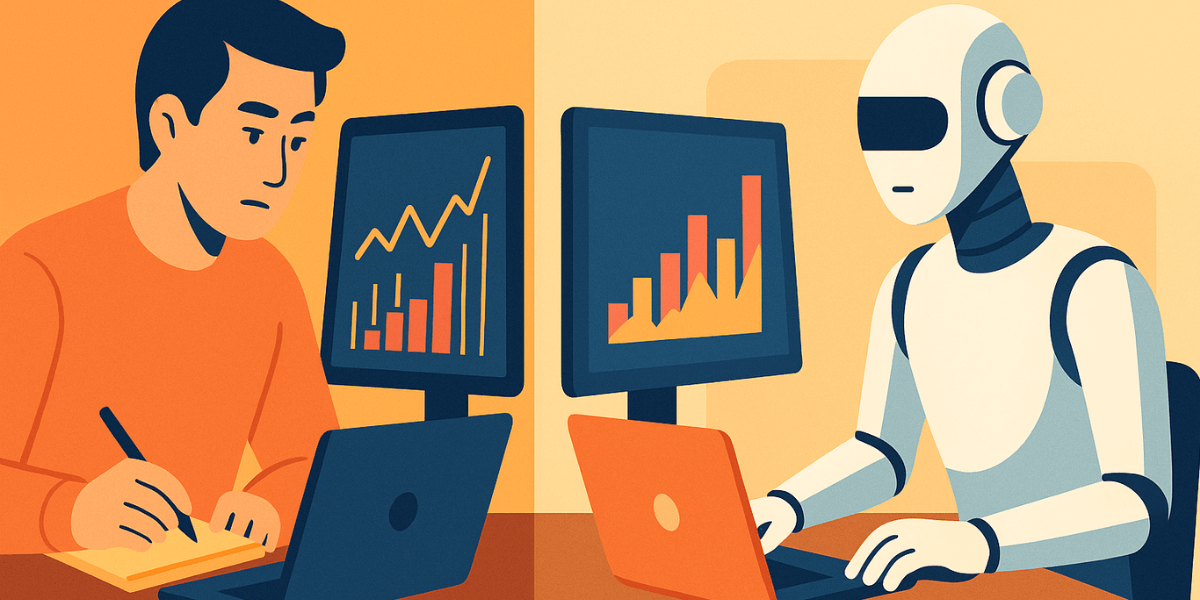
Across Asia’s universities, a quiet revolution is taking place in dorm rooms, campus libraries, study cafés, and late-night coworking spaces. Students who once relied purely on intuition, chart patterns, or quick social media tips are now turning to artificial intelligence to automate large parts of their technical analysis. What began as curiosity—testing AI chatbots, feeding indicators into simple code blocks, experimenting with prompts—has transformed into a widespread student-driven movement reshaping how young traders approach the markets. For many, AI has become both tutor and tool: a way to accelerate learning, validate strategies, and generate structured insights that previously required far more experience.
Asian students, known for their high digital fluency and rapid adoption of new technologies, are particularly quick to leverage AI-driven solutions. From Singapore to Seoul, Kuala Lumpur to Manila, students are using AI not only as a guide but as an active participant in the analytical process. They ask AI models to scan charts, identify patterns, summarize market behavior, detect trend changes, or simulate scenarios that would be difficult to process manually. The integration is not always perfect, and it comes with risks that students rarely consider, but it reveals the beginning of a new era in which AI quietly sits beside the trader.
This article explores the evolving relationship between Asian students and AI-driven technical analysis: why they turn to these tools, how they actually use them, what advantages they gain, and how these new habits are reshaping the early development of trading skills across the region. Beneath the surface lies a complex blend of intellectual curiosity, academic pressure, financial aspiration, and digital culture—forces that make AI an irresistible companion for the new generation of traders.
The Academic Mindset Behind AI Adoption
Students in Asia are used to working with structured systems. Their daily lives revolve around exams, deadlines, revision cycles, and quantifiable progress. AI appeals to them because it fits seamlessly into this mindset. When an AI model produces a detailed explanation of price action or an organized breakdown of market structure, it mirrors the clarity they are trained to seek in academic environments. It is not just that AI offers information; it offers it in a format that feels familiar, structured, and efficient.
Students often describe AI as a “shortcut to comprehension”—a way to bypass the overwhelming flood of market data and get straight to the essential insights. Instead of navigating complex forums or unclear tutorial videos, they request direct explanations tailored to their level of understanding. If they struggle with indicators, they ask AI to explain them step-by-step. If they do not understand chart patterns, they ask for simplified interpretations. AI becomes a learning accelerator, compressing hours of manual research into minutes of interaction.
This academic-oriented approach also makes AI particularly appealing to students balancing trading with demanding coursework. Time efficiency becomes crucial. When they can automate technical analysis or rely on AI to summarize market conditions, they feel empowered to stay engaged with markets without sacrificing academic obligations.
The Dorm Room Labs: How Students Actually Use AI in Daily Trading
One of the most fascinating aspects of this trend is the environment in which AI-driven technical analysis occurs. Much of it happens outside formal financial settings. Students run backtests on laptops in shared dorm rooms. They prompt AI models on tablets while waiting for classes. They analyze patterns on their phones during late-night study breaks. AI is not simply a tool—they treat it as an on-demand assistant integrated into their lifestyle.
Students use AI in several informal yet innovative ways. Some ask AI to interpret chart screenshots they upload. Others request that AI restructure their messy trading notes into coherent plans. Many request confirmation for their ideas, asking questions like “Is this a breakout or just a retest?” or “Does this look like a false reversal?” Even though AI is not truly viewing live market data or executing trades, students rely on it to refine their thinking and reduce uncertainty.
The most significant use case, however, is automation of analysis. Students prompt AI models to build scripts, indicators, or formulas they can plug into trading platforms. They ask AI to create scanner conditions that detect certain technical patterns. They request optimization suggestions for strategies they are testing. Over time, the combination of curiosity and experimentation shapes an environment where AI is not only a passive advisor but an active engine in the student’s analytical workflow.
Why AI Feels Like the Perfect Trading Partner for Students
Students gravitate toward AI for three key reasons: confidence, clarity, and convenience. First, AI boosts their confidence by providing seemingly authoritative explanations. When students receive clear answers, they feel reassured, even if they lack deep experience. AI’s ability to summarize complex data gives them the sense that they are learning faster than traders in previous generations.
Second, AI clarifies confusion. Technical analysis can be dense and contradictory. Indicators often send mixed signals, and chart patterns require experience to interpret correctly. Students ask AI to explain conflicts and interpret gray areas. AI responds with structured reasoning, which reduces cognitive overload. For students accustomed to studying with digital tools, this structured clarity feels natural and reliable.
Third, AI is convenient. Students can access it anytime—during a lecture break, while commuting, or in the middle of a late-night study session. The flexibility of AI fits their unpredictable schedules. They do not need full charting systems or heavy software. A phone and a chatbot are enough to run entire analysis cycles.
Automating Technical Analysis: What Students Are Building With AI
The most advanced student traders use AI to build automated tools and strategies. This includes scripts for scanning chart patterns, formulas for detecting volatility shifts, and basic automation for tasks such as risk calculation. Some ask AI to create bots that track support and resistance levels or indicators that signal trend shifts based on candle patterns.
Others go further, automating backtests or creating simplified versions of trading algorithms. Although these tools are often rudimentary compared to professional systems, they demonstrate remarkable initiative. Students treat AI not just as a tool to consume information but as a tool to generate solutions.
This shift dramatically accelerates the learning curve. Instead of spending years manually experimenting with every indicator or pattern, students construct and test ideas in days. They can request modifications, ask for optimization, and iterate rapidly. The speed at which they move from concept to prototype would have been unimaginable a decade ago.
The Influence of Campus Culture and Peer Collaboration
Campus culture plays a significant role in how students adopt AI tools. Trading groups have formed in universities across Asia, where students share prompts, scripts, and entire backtesting frameworks. Some collaborate on building AI-powered dashboards or join Discord groups dedicated to student trading labs. The collaborative culture accelerates the spread of ideas and tools.
In universities with strong technical programs, such as engineering or computer science faculties, students often bring their coding knowledge into trading circles. They teach others how to integrate AI-generated scripts into trading platforms. Meanwhile, students from economics or business backgrounds focus on strategic interpretation and risk modeling. The combination of these skill sets creates a uniquely powerful environment for AI-driven experimentation.
The community dynamic amplifies motivation. Students feel they are building something together, not trading alone. The sense of belonging increases their willingness to push boundaries and test new ideas, which further strengthens the integration of AI into campus trading culture.
The Risks Students Rarely Consider
Despite the excitement surrounding AI-driven technical analysis, students rarely acknowledge the risks. The most significant risk is overconfidence. AI-generated explanations can make students believe they understand markets more deeply than they actually do. The confidence produced by AI clarity can mask the absence of real trading experience.
Another major risk is misinterpretation. AI models do not read real-time charts or execute trades. They interpret only the inputs provided. If a student misreads a screenshot, draws an incorrect conclusion, or provides incomplete data, the AI will generate an analysis based on flawed premises. Students often mistake this analysis for objective truth, leading to decisions built on misinformation.
A subtler risk is the erosion of intuitive market understanding. Students trained from the beginning with AI assistance may develop less experiential judgment. Technical analysis historically relied on hours of manual observation—internalizing market rhythm, price behavior, and psychological cues. Excessive AI reliance can weaken these instincts, making traders vulnerable in fast-moving or ambiguous market conditions.
AI as a Learning Tool vs. AI as a Crutch
The distinction between using AI as a tool and using it as a crutch defines whether students mature into competent traders. When AI is used to reinforce learning, clarify confusing topics, or accelerate conceptual development, it becomes a powerful supplement. When AI is used as a replacement for thinking—performing analysis automatically, making decisions for the trader, or generating signals—students risk bypassing the deep learning required for long-term survival.
Some students already show signs of over-dependence. They ask AI to confirm every decision, interpret every candle, or validate every assumption. This creates a feedback cycle where the student is no longer learning trading logic but only learning how to phrase prompts effectively. The danger is that these students become strong AI operators but weak traders.
Balanced usage involves allowing AI to teach but not to decide. Students who combine AI guidance with independent reasoning develop the strongest foundation. They use AI to explore, test, and accelerate, but not to outsource judgment.
The Regional Differences in AI Adoption
AI adoption varies significantly across Asian countries. In Singapore, where education is highly structured and technology is fully integrated into academic life, students use AI in sophisticated ways, often incorporating coding and automation. In Indonesia and the Philippines, AI tends to be used more for explanation and interpretation. Students rely on it to break down confusing concepts or simplify strategies.
In South Korea, the adoption is driven by the country’s tech-forward culture. Students integrate AI into both crypto and equity analysis, often focusing on high-frequency retail strategies. In Malaysia and Thailand, AI usage is heavily influenced by community groups and peer learning environments. Students share prompts, discuss strategies, and create collaborative experiments.
These regional differences reflect broader cultural patterns. Where educational systems emphasize structure, students use AI as an organizational tool. Where community culture is strong, AI becomes a shared experiment. Where technology adoption is rapid, AI becomes an extension of digital identity. In all cases, the integration is accelerating and deepening.
The Future of Student Trading in Asia: AI as the New Normal
AI is not a passing trend for student traders. It is becoming embedded into how they learn, analyze, and eventually trade. The next generation of Asian traders will blend human intuition with AI-accelerated workflows. They will expect to interact with markets through hybrid systems rather than purely manual frameworks. This shift will affect how brokers design platforms, how educators teach courses, and how trading communities evolve.
As AI models grow more advanced, students will increasingly use them to simulate scenarios, predict reactions, and optimize strategies. However, the line between support and dependency will remain important. The future will belong not to traders who rely on AI blindly, but to those who combine AI’s computational strength with human strategic judgment.
Conclusion
Asian students are using AI for automated technical analysis because it aligns perfectly with their digital lifestyle, academic mindset, and desire for accelerated learning. AI offers structure, clarity, speed, and experimentation, making it an attractive partner in early trading development. But it also introduces risks of overconfidence, misinterpretation, and weakened intuition.
As AI becomes more deeply integrated into the student trading ecosystem, the most successful young traders will be those who learn to balance automation with personal judgment—using AI not as a replacement for skill development but as a catalyst for deeper understanding. The future of Asian trading will not be defined by technology alone, but by the synergy between student ambition and AI’s ability to guide it.
Frequently Asked Questions
Do students rely too much on AI for technical analysis?
Some do. While AI accelerates learning, excessive dependence can weaken intuition and reduce long-term skill development.
Can AI tools help students become better traders?
Yes, when used to clarify concepts, accelerate research, or build prototypes. AI becomes harmful only when students outsource decision-making entirely.
Are AI-generated strategies reliable?
They can be useful starting points, but they must be validated through backtesting, manual review, and real-world observation.
Will AI dominate student trading across Asia?
AI will become increasingly integrated, but human judgment and emotional control will remain essential for sustainable success.
Note: Any opinions expressed in this article are not to be considered investment advice and are solely those of the authors. Singapore Forex Club is not responsible for any financial decisions based on this article's contents. Readers may use this data for information and educational purposes only.